
Thiruvananthapuram: Kerala-based spacetech startup HEX20 has been selected by the UAE Space Agency to develop an asteroid probe spacecraft, becoming the first private company from India to be onboarded for a deep space mission by the Gulf nation.
The Technopark-based startup, which built India’s first rideshare satellite in the private sector, has developed the spacecraft bus and software for the asteroid probe spacecraft as part of the Emirates Mission to the Asteroid Belt.
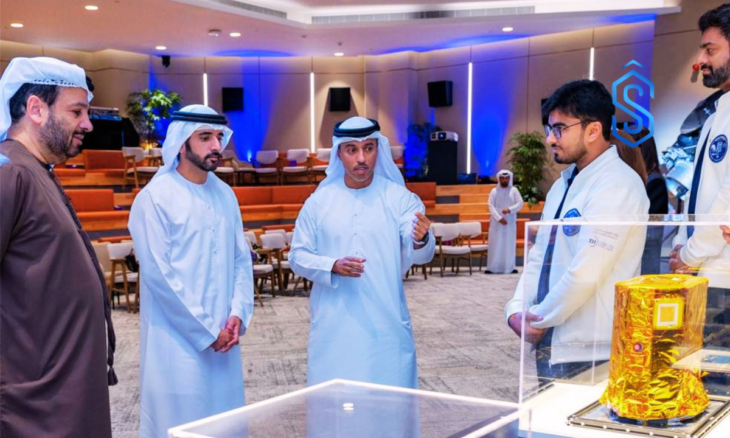
The spacecraft system was unveiled before His Highness Sheikh Hamdan bin Mohammed bin Rashid Al Maktoum, Crown Prince of Dubai, Deputy Prime Minister and Minister of Defense.
The unveiling marked a significant milestone for the Emirates Mission to the Asteroid Belt, with HEX20 contributing its spacecraft engineering capabilities to the UAE’s ambitious interplanetary programme.
HEX20 Selected for UAE Asteroid Mission
HEX20 was selected by the Technology Innovation Institute (TII) and the UAE Space Agency in November 2024 following a design workshop to develop the asteroid probe spacecraft.
The company has an engineering presence at Technopark in Thiruvananthapuram, while its UAE operations are based in Masdar City.
HEX20 is contributing spacecraft engineering expertise to the interplanetary programme, including the spacecraft bus, the platform supporting the probe’s payload and operations, and software developed to meet the mission’s technical requirements.
For the asteroid probe spacecraft, HEX20 has developed a novel onboard computer and power systems designed to operate in the harsh environment of deep space.
The company delivered its service within 15 months through focused engineering, sustained effort and close collaboration with project partners, while maintaining quality and meeting mission requirements.
HEX20 CEO on Asteroid Probe Spacecraft
Amal Chandran, Chief Executive Officer, HEX20, said: “The achievement underscores HEX20’s capabilities in delivering spacecraft systems for demanding missions.
The probe spacecraft has been assembled in Abu Dhabi by TII’s Propulsion and Space Research Center, along with the UAE Space Agency, HEX20, Khalifa University and UAE University’s National Space Science and Technology Center.”
“It will next travel to Colorado for integration with the MBR Explorer. Scheduled to launch in March 2028, the MBR Explorer will travel approximately five billion kilometers over eight years.
Gravity-assist maneuvers around Venus, Earth and Mars will shape its journey into the main asteroid belt, where it will fly past six asteroids before reaching its final target, asteroid 269 Justitia,” Shri Chandran added.
MBR Explorer Mission to Asteroid 269 Justitia
After the MBR Explorer enters orbit around 269 Justitia, the asteroid probe spacecraft will separate and descend autonomously towards the asteroid’s surface.
Justitia’s unusual reddish appearance makes it a compelling scientific target. Researchers believe it may have originated in the distant Kuiper Belt before migrating into the main asteroid belt.
Studying its surface could provide evidence about organic material and the distribution of water and other volatile substances during the formation of the Solar System.
The autonomy of the asteroid probe spacecraft is a defining engineering challenge of the mission.
While the MBR Explorer remains in communication with mission control, the probe will have to execute its onboard programme independently, without control from Earth-based operators.
The autonomy embedded in the software represents a significant capability developed by HEX20. The company said this capability can also be applied in many Earth-based monitoring applications.
HEX20’s Global Space Technology Presence
HEX20 has a presence in the US, UAE and Taiwan. The company builds payload-agnostic satellite platforms and offers satellite mission-as-a-service and payload hosting capabilities for customers conducting in-orbit demonstrations.
Through its role in the UAE’s interplanetary programme, HEX20 is contributing its spacecraft bus, onboard software, computer and power-system capabilities to the asteroid probe spacecraft that will eventually descend autonomously towards asteroid 269 Justitia.